
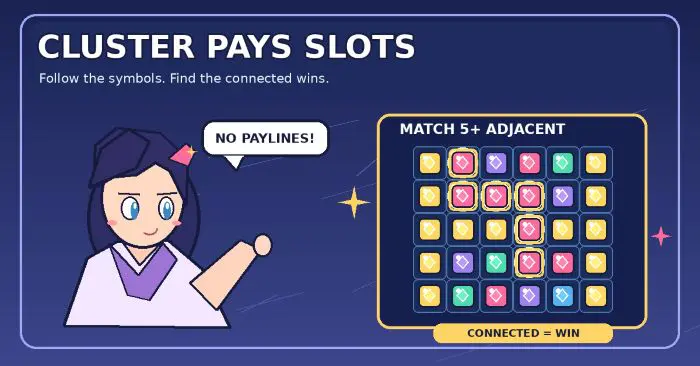
The first time I spun a Cluster Pays slot, I had to wait about ten spins for something to line up. There was never going to be a line-up because there are no lines. Symbols popped up, disappeared and rained down from the top of the screen, and my bank balance kept fluctuating in small amounts I didn’t understand. If that seems familiar, then this is the guide for you. Cluster Pays slots initially seem chaotic; however, the basic rules governing them are simple once someone explains them to you.
Here’s how cluster wins work, how grid sizes affect gameplay, what cascading reels actually do, and how Cluster Pays formats compare to paylines, Megaways, and scatter pays. You’ll also receive an unbiased explanation of RTP (return to player) and volatility, as the grid affects how you win. However, it doesn’t affect the odds you’re playing against.
What are Cluster Pays slots?
Cluster Pays slots abandon the concept of paylines. As a traditional slot machine only pays when matching symbols are lined up across the reels in a specific manner, either from left to right or vice versa, a Cluster Pays slot pays when there are sufficient matching symbols touching one another in the grid regardless of their location.
When we say “touching,” we mean that symbols are considered connected if they sit beside each other either horizontally or vertically. Diagonally positioned symbols usually don’t qualify as being connected, although a few games are flexible with this – therefore check the game information panel prior to assuming anything. When you create a group of identical symbols sufficiently large, that group constitutes a successful cluster.
As such, you’ll also hear them referred to as grid slots or grid based slots due to the fact that they usually utilize a rectangle or square matrix rather than the traditional five reels and three rows. NetEnt pioneered this approach in the mid-2010s, and as such, it has been adopted by practically all major studios, including Play’n GO, Pragmatic Play, and Push Gaming, who all possess well-known titles utilizing this style.
How Cluster Pays slots function on a spin-by-spin basis
Each spin begins similarly to every other type of online slot. A random number generator determines which symbol occupies each grid position. Following that, the game checks for any clusters composed of adjacent matching symbols that meet or exceed the minimum cluster requirements.
Minimum cluster requirements vary far more than you’d expect. Five symbols is the standard minimum, and as you’ll see, that’s the case in Reactoonz, Jammin’ Jars, and Fruit Party. NetEnt’s Aloha! Cluster Pays requires nine. While having a larger minimum doesn’t inherently make a game poor, it merely indicates that the pay table was constructed using that as a baseline. Since each symbol provides greater value for larger clusters (for example, a cluster of fifteen cherries could provide numerous times the amount of a cluster of five), an increase in cluster size typically equates to increased payout values.
Cluster shape doesn’t matter
An L-shaped grouping of symbols, a snake-like grouping of symbols stretching across the entire grid, or a grouping of symbols forming a bulky mass in one area of the grid — regardless of shape, if every symbol in the grouping contacts at least one additional symbol within said grouping, that represents a single cluster. Two distinct groupings of identical symbols which do not contact One another represent Two individual groupings of symbols which were each awarded individually for their respective clusters. This is confusing for individuals who witness eight purple gems on the grid and only receive payment for five.
Grid size & symbol layout
While certainly more important than any other factor, grid size influences how a player experiences each game significantly. A small grid tends to be felt tightly while a large grid tends to be felt as cluttered and busy and as such, the math behind each experience differs greatly.
NetEnt’s Aloha! Cluster Pays utilizes a 6×5 grid layout which is essentially similar to a traditional display, except for the addition of an extra column. Reactoonz and Fruit Party operate off 7×7 grids. Jammin’ Jars operates off an 8×8 grid which presents sixty-four unique grid spaces per spin. With more opportunities for symbols to interact with each other, developers frequently counterbalance this by increasing the number of symbol types utilized within the game, increasing the minimum required cluster size or decreasing the payout for a given cluster size.
You will also encounter 5×5 and 6×6 grids commonly in puzzle-style or match-three slots that take heavy influence from mobile gaming apps such as Candy Crush. Additionally, some games will begin with a small grid and increase the size of their grid during free spins. Therefore, more space is presented to players and cluster wins become much simpler exactly when Multipliers typically grow larger, which is where most games build their excitement.
Cascading reels/chain wins
Cascades are perhaps the defining feature where cluster pay slots truly shine. Nearly all cluster pay slots employ some iteration of this feature. Although they may refer to Cascades by various names such as cascading reels, tumbling reels, avalanche reels or “reactions,” they represent virtually identical concepts with varying terminology.
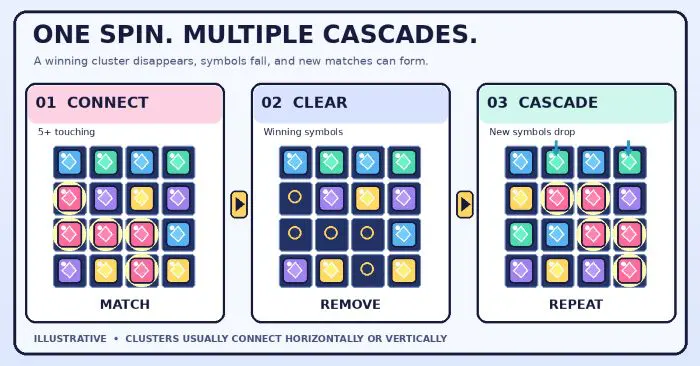
Let me walk you through the process. On each spin the game initiates in a manner identical to every other online slot. The random number generator assigns a symbol to each grid position. At that point, the game evaluates the newly created grid to determine any clusters comprised of adjacent matching symbols meeting or exceeding the minimum cluster size.
Following completion of this evaluation process, should any clusters be identified as meeting the required criteria they generate payouts. Upon paying out the winning cluster(s), the winning symbols immediately vanish from view. The remaining symbols located above the vacant space fall downward into the vacant space(s). New symbols enter from atop the grid. Should the newly arranged configuration establish additional clusters upon completing this process (the subsequent cascade), said clusters shall generate payouts. This process continues until no further Cascades occur; thereby establishing finality on a given spin.
This is precisely why your bank balance appears to move in unpredictable ways throughout each spin. A single wager can potentially generate a chain reaction of numerous small wins (a string of Cascades) and that chain reaction is what usually initiates features such as progressive jackpots and/or Multipliers. Reactoonz is an exemplary illustration. For each winning cluster generated, Reactoonz awards points toward activation of special features, including removal of all instances of certain symbol(s) on each spin and ultimately an enormous gargantuan symbol.
Although Gonzo’s quest isn’t classified as a cluster pay slot (it employs 20 paylines), it is worth mentioning here because it was instrumental in making avalanche-style features popular (in addition to providing the model upon which many modern-day cluster games have drawn).
Wilds/Multipliers/bonus features
Cluster pay slots also incorporate their own interpretation of typical bonus tools. Wild symbols serve their purpose (substitute for any non-wild symbol to facilitate completion or expansion of a cluster); due to their ability to participate in any direction within a cluster, an individual wild situated centrally in a grid may occasionally cause Two previously unconnected clusters (which would otherwise have received payment separately) or caused neither to receive payment.
Multipliers represent perhaps the largest aspect of variation among cluster pay slots. Jammin’ Jars has Multipliers as its primary focus. Jammin’ jar symbols are wild symbols that remain visible in the grid after each cascade and obtain an increasingly larger multiplier with each successful win featuring those Jars. Multiple Jars can combine and accumulate Multipliers independently and collectively. Fruit Party randomly associates 2x Multipliers with winning clusters; these Multipliers can stack upon one another as well. Free spins usually initiate randomization of Multipliers at lower rates than during normal play; however, once initiated, Multipliers accumulate progressively throughout free spins, resulting in an exponential growth rate of winnings.
Additional features you may encounter include: upgrading low-paying symbols to higher paying versions; dropping random wilds onto the grid; eliminating all non-winning symbols in exchange for resetting the grid; displaying sticky wilds that remain present for multiple spins; and accumulating points toward unlocking features via a meter displayed along-side the grid. Bonus buy is offered by some games allowing players to purchase entry into free spins at a fixed number of times their base-stake (usually ranging from seventy times their bet upwards). Be cautious regarding bonus buy options: due to high volatility, bonus buy can be expensive and may not be available in all jurisdictions (UK Gambling Commission prohibits bonus buy for UK players).
Cluster Pays slots comparison to paylines
This is likely the comparison that matters most for beginners. Traditional payline slots employ fixed paths across the reels. Starburst, for example employs ten paylines payable both ways; thusly only symbols residing on those paths qualify for payment. Land three identical symbols aligned in a path that does not constitute a payline and you collect zero dollars.
Since there are no paths (paylines) in Cluster Pays slots, positioning within the grid does not impact whether you win or lose – only whether adjacent symbols exist. Thus, Cluster Pays games usually utilize Cascades, whereas payline games can simply spin again, but on a grid, new arrangements are needed for new clusters to form.
Regardless, RTP (return to player) and volatility do not differ between these formats — neither format is “tighter” nor “looser.” whether or not RTP/volatility exists as a result of how a developer adjusted his game design; not due to which type of win format he employed.
Comparison between Cluster Pays slots and Megaways/scatter pays
Players consistently confuse these three formats with one another — and reasonably so — as they can all resemble a grid full of falling symbols.
Megaways — developed by Big Time Gaming and first utilized in Bonanza — retains reels but allows each reel to display a variable quantity of symbols per spin; henceforth modifying the quantity of possible combinations for each spin up to 117649 ways in the original configuration. Megaways maintains its traditional left-to-right payment method — but now only requires an appearance on each adjacent reel rather than on a predetermined line. Virtually all Megaways slot machines employ Cascades — creating additional similarity.
Megways and Cluster Pays slots differ primarily in regards to reel utilization: megways retain reels whose height varies per spin; Cluster Pays utilize an actual grid — both methods reward players for successful clusters formed by adjacent symbols in any orientation.
Megways and scatter pays differ in regard to whether adjacent or scattered symbols are necessary for awarding prizes: adjacent symbols are required for Cluster Pays awards — scattered symbols are required for scatter pays awards.
Cluster Pays slots examples
If you wish to see how diverse Cluster Pays slots can be — here is a selection of notable examples covering most of the spectrum:
Aloha! Cluster Pays from NetEnt serves as an introductory title to demonstrate how Cluster Pays works. It has a 6×5 grid layout with 9-symbol clusters, sticky win respins holding winning clusters in place while re-spinning other elements on the board and it’s relatively calm compared to others in its family — perfect for learning how clusters link.
Reactoonz by Play’n GO is likely one of the most famous examples — 7×7 grid layout with 5-symbol clusters — charging meter — chaotic elements — personality galore — prolonged punishment — but demonstrates best how Cascades & features link together!
Jammin’ Jars by Push Gaming has an 8×8 grid layout and multiplier focus – sticky wilds – free spins – Multipliers grow over sequence – this is why it has such devoted followers.
Beginning tips
None of the above will improve your odds—but it may help you play with your eyes open:
Play demo mode first – all but rare exception have free play modes and twenty minutes of demo spins can teach you more than any pay table.
Read the pay table regarding cluster sizes – check minimum cluster requirements — check scale factors used for payment values based on cluster size — check to see which direction diagonals are allowed.
View the game info panel for RTP – do not assume it is similar to what you saw on a review site.
Assess match volatility to your budget – high volatility 8×8 games can burn small bankrolls quickly — smaller bets or less aggressive games may suit better.
Set limits prior to spinning – utilize deposit limits — loss limits — session reminders — treat money like cost of entertainment.
Cluster Pays FAQs
What are Cluster Pays slots?
These are grid-based slot machines whereby payment occurs when sufficient matching symbols contact each other rather than landing on fixed paths.
How many symbols do I need to win a cluster?
Ordinarily five; though this requirement varies by game title. Net ent’s version of Aloha requires nine. Each pay table always specifies the number needed to win.
Do Cluster Pays slots possess pay lines?
Yes and no. Wins depend solely upon the presence of adjacency amongst symbols and not lines — hence they are frequently called slots without pay lines.
Do Cluster Pays slots employ reels?
From a technical standpoint yes they still function as columns as symbols fall down from Cascades as well as drop into vacated space after winning combinations disappear; although most players refer to their layout simply as a grid.
What are cascading reels in cluster slots?
After winning combination(s) pay out winning symbols immediately disappear and new symbols fall down into vacated spaces; if these new arrangements create additional clusters then said clusters shall also generate payouts — meaning single spin can potentially produce numerous winnings consecutively throughout a cascade process.
What is the difference between Cluster Pays and megaway?
Megaway keeps reels with changing heights and pays left-to-right across ways; while Cluster Pays uses a grid and pays for connected groups in either horizontal or vertical orientation regardless of group shape.
What is the difference between Cluster Pays and scatter pays?
In both formats, the symbols must connect for payment; in contrast to scatter pays, where symbols only require appearance somewhere within large enough numbers on the grid.