
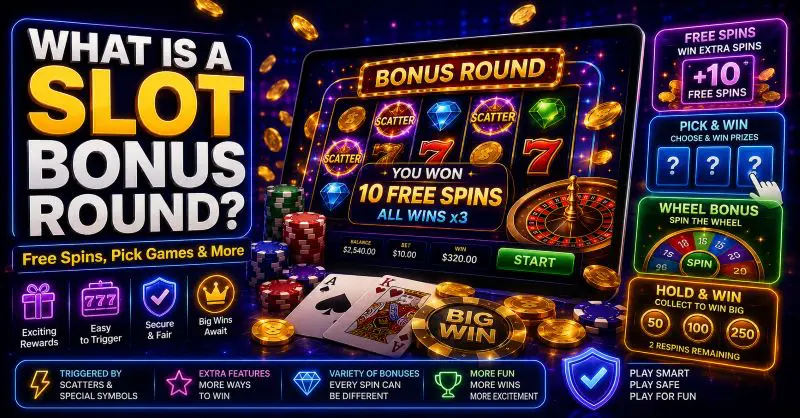
Slots have two lives. First, there is the base game – the primary section of the game where you’re mainly engaged in spinning the reels and seeing small wins come back into your account. Then there’s the second life, where the reels change shapes, the soundtrack changes keys and you stop spinning altogether. This is the bonus round, and if you’ve ever asked yourself “what is a slot bonus round” and “why do all players seem to go after it?” then this post will help explain everything from scratch.
In basic terms – a bonus round is a secondary or alternative mode within an online slot (or video slot) that operates under different rules than the base game. In addition, the main goal of the bonus round is generally to increase the level of variety and excitement within an otherwise fairly repetitive process.
Plain English explanation of Slot Bonus Rounds
A slot bonus round is an added feature in a video slot or online slot, which temporarily alters how the base game functions. As opposed to the continuous loop of spin-bet-repeat, you’ll receive something else – possibly free spins, a select-and-winner screen, a spinning wheel, a walk-around board, etc., and possibly reels that function differently than in the base game. Essentially, a bonus round creates a distinct secondary game-layered on top of the primary game — and its purpose is primarily to introduce variance into what could otherwise be a relatively uneventful experience. To avoid confusing newcomers, it’s helpful to distinguish between the base game and the bonus game.
The base game is simply spinning reels for cash repeatedly at whatever stake you choose. Conversely, the bonus round is a specific, independent sequence of gameplay (which may last anywhere from 10 seconds to several minutes), which takes place according to its own unique rules prior to returning you to the base game. While some bonus rounds use the exact same five reels you initially spun, others discard them altogether and replace them with a wheel, a board or a grid of clickable items.

How Bonus Rounds Are Triggered Within Slots
Triggers differ greatly based on games. However, there is one general trend worth noting. Some games are more restrictive and demand that the scatter symbols appear on certain reels (for example reels one, three and five). Other games are more lenient and count scatters regardless of where they occur. Certain titles also employ 4 or 5 scatters as prerequisites for higher tier bonus rounds and subsequent better features behind fewer triggers. Bonus symbols are similar to scatter symbols but serve different purposes. An icon specifically designated as a “bonus” or “feature” symbol only serves to unlock the secondary game. Scatter symbols may also generate small scatter payouts, but serve another purpose — to unlock the larger secondary game. Examples of such games include titles using icons that allow a very clear distinction between “this symbol generates a small scatter payout” versus “that symbol unlocks large secondary features”.
Another aspect related to bonus rounds includes bonus buy. Bonus Buy has become increasingly popular among newer online slots with particular emphasis on attracting more mature audiences. Bonus Buy allows you to purchase access to a bonus round by spending a one-time payment of varying stakes (commonly between 50x to 150x your typical stake). The controversy surrounding Bonus Buy stems from its ability to eliminate anticipation associated with experiencing a bonus round. Further, Bonus Buy is subject to restrictions or prohibitions in many regions due to its direct packaging of high-stake betting into a single button press. Newcomers to slots, I highly recommend avoiding this feature until you have developed sufficient knowledge regarding the underlying mathematical structure of the game and are able to determine whether the cost represents reasonable value.
Primary Types Of Bonus Round Features You Will Experience
After activating a bonus round, the specifics of what occurs vary widely depending upon both studio/developer and title-specific implementations. However, most bonus round implementations belong to one of a limited number of recognizable categories. By far, free spins are the most prevalent category of bonus round feature encountered by slot enthusiasts. If you’ve spent any considerable amount of time playing slots, you’ve probably already experienced one or more free spin bonus rounds. In essence, a free spins feature awards you a predetermined number of free spins (typically ranging from 8 to 20), in which you don’t utilize your own funds to bet.
While the term “free” conveys significant meaning — what distinguishes free spins from being somewhat uninteresting is what developers implement above and beyond free spins themselves. Most developers provide multipliers that accumulate with each winning spin throughout a free spin feature. Many developers also provide sticky wilds that remain locked in position for the duration of a free spin feature. Additional wilds provided by developers include expanded wilds (which expand to cover entire reels) and stacked wilds (where multiple wilds are placed atop one another on a single reel). A few developers further enhance free spins by including expanding reels (increasing the dimensions of the standard 5-reel x 3-row layout to greater numbers of reels — i.e., 6 or 7 reels — thereby significantly enhancing potential combinations of winnings during the feature).
Free Spins typically end after exhausting all possible options or revealing a collect symbol that concludes the feature prematurely. Due in large measure to their engaging tactile nature, many find free-spins-based bonuses more enjoyable than standard spinning and less reminiscent of true gambling. Additionally, this tactile quality lends itself well to providing a sense of participation in what feels more akin to a TV game show segment — which is likely part of their appeal for casual players. Wheel-based bonuses are another variation where large wheels are presented displaying various prizes/multiplier values. You receive one or more spins on the wheel, and whichever space on the wheel lands provides your reward. Board-based bonuses are yet another variation, providing more complex experiences. Typically, you roll dice or spin a mini-wheel to move tokens along paths featuring various spaces that award cash rewards (and occasionally mini-games/multipliers/bonus rounds) as you progress through the board.
Hold-and-win bonuses (also referred to as respin bonuses) operate under differing principles from previously described variations. When you encounter specific symbols on your grid, instead of concluding the round when they land, the system locks those symbols in-place and grants you a set number of respins (usually between 2-5). Each time you successfully land an additional copy of the same symbol-type(s), you reset your remaining respin allowance. Once you’ve exhausted all respins without landing additional copies of said symbols, all locked-in symbols on your grid are tallied up according to their respective values.
Beyond these core categories, many games integrate fully immersive bonus mini-games that share little-to-no visual similarity with your original slot reels.
For Beginners – Expectations About Bonus Rounds
Here lies the biggest misconception among players bonus rounds happen infrequently due to how mathematically constructed slots are designed. The rate at which naturally occurring bonus rounds happen is directly linked to how a given game’s math model was constructed. A slot with approximately 1 bonus round every 100-300 spins is perfectly acceptable; however, many high-variance titles limit this occurrence even farther out (i.e., ~1 in 500).
This explains what many people refer to as “feature frequency” or “hit frequency,” and it’s important to understand before starting your next gaming session hoping for bonus rounds every few minutes. Feature frequency directly correlates to volatility levels within bonus rounds. Lower-volatility slots tend to award smaller (but more frequent) bonus rounds that offer modest payouts compared to their counterparts; whereas high-volatility slots offer longer waits between bonuses but potentially deliver payouts capable of paying tens (even hundreds) of times your original stake.
Ultimately, neither approach is inherently superior it’s largely dependent upon what type of gaming session you wish to create for yourself. If your budget is constrained and you desire for your money to last longer lower-volatility offers steadiness; conversely high-volatility can lead to shorter gaming sessions offering larger payouts.
One critical piece of information often overlooked relates to how your current wagering stake affects your total payout in bonus rounds your current wagering stake will carry over into your bonus round and will dictate its overall value. Therefore free spins awarded at $1 stake will produce substantially different results than free spins awarded at $5 stake despite utilizing identical multipliers/symbols. This is one major reason why attempting to raise your wager immediately prior to receiving a feature trigger is ultimately impossible to predict/control. Likewise this highlights why “bonus-buy” product offerings are priced as such.
RTP is essentially a theoretical long-term average (not guarantee) and therefore while not necessarily directly applicable to individual sessions it remains arguably the best metric for comparing games; virtually all reputable studios explicitly list RTP figures in their marketing materials. Approximately 96% RTP is considered average; any percentage significantly below this should warrant attention.
That final note is far more impactful than many realize. The randomness inherent within bonus rounds is what contributes to their excitement; however this same unpredictability can lead individuals chasing features that are overdue in their heads but lack any recollection of their previous 100+ spins. Math doesn’t operate this way; treating it as such is how gaming sessions can quickly spiral out-of-control for players.
There’s also an advantage-related side to this sometimes referred to as Advantage Play where sharp players track items such as: posted Jackpot Meters; Price vs Expected Value of Bonus-Buy products; or Hold-and-Win Symbol Density on Physical Cabinets. Advantage Play is predominantly pursued by a sub-set of Serious Players and doesn’t neatly translate to most Modern Online Slots where Mathematical Models are locked-down-tight.
From an educational perspective, what’s perhaps more beneficial for the bulk of readers interested in Beginner Guides relating to Slot Bonus Rounds is that while recognizing that features exist & what typically activates them establishing your budget & limits prior to initiating a session (as opposed to mid-session) will afford you more peace-of-mind.